


Bestiary
Afanc
Kraken
Banshee
Manticore
Basilisk
Nemean Lion
Boggart
Phoenix
Buraq
Questing Beast
Calygreyhound
Rasselbock
Catoblepas
Sea goat
Chimera
Simurgh
Cockatrice
Skolopendra
Demons
Sphinx
Dragons
Spider-people/ Edderkopfolk
Dullahan
Tarasque
Enfield
Tatzelwurm
Ghost
Unicorn
Ghoul
Vampire
Griffin
Will-o-wisp
Hellhound
Wraith
Hippocampus
Wyvern
Hydra
Ypotryll
**It is to be noted that this is by no means a complete list of the monsters and supernatural animals in the world of Materna. There are more above the ground, below the ground, and in the waters. There are even more in distant continents, yet to be discovered.
Afanc
An afanc is a swamp or freshwater creature. It's a semiaquatic mammal that lays eggs in clutches of two, sometimes three, at a time. Its beaver-like body is the size of a large dog. It has a beaver-like head with a somewhat longer, fanged snout. It has an eight to ten-foot-long (2.44-3.05 m) tail, with spikes running down the spine of the tail. Its body is covered with scaly fur that is difficult to penetrate with normal weaponry. It is also capable of camouflaging to visually blend into its swampy environment. Though it is sometimes described as turning invisible, this is a misconception. It can only camouflage in shades of brown and green.
They are native to southern Croulia and Gleann Rois.
Basilisk
A basilisk is a serpentine creature. It lays eggs in clutches of ten to twenty eggs. When it hatches, it is around two to three feet in length. It has no known upper end to its size and will continue to grow larger and larger as it sheds its skin. They reach maturation at around ten feet in length. Baby basilisk will sometimes eat their siblings, both hatched and unhatched, if there is not a source of food readily available. Mother basilisks usually care for their young until they reach about five feet in length, but may also feed on their young if there is no alternative food source readily available.
Basilisks are poisonous. If a person or animal is bitten by a basilisk, they will start going into paralysis within a minute or two. The affected person will die from their internal organs shutting down within a couple of hours if left untreated. Basilisks also have a paralyzing stare. When a person makes eye contact with a basilisk, it temporarily frazzled their nervous system so they freeze. This freezing effect only lasts for a few seconds but can be deadly, as it allows the basilisk time to bite its prey and paralyze them with poison. Because of this, some have speculated that basilisks can 'turn someone to stone with just a stare,' however, this is a misunderstanding of the fact that the stare freezes someone long enough for the basilisks to paralyze them with their poison.
Basilisks are found in sewers, tunnels, and swamps, typically in central Materna.

This is an AI Generated Image.
Boggart
A boggart is a chimpanzee-like mammalian creature with brown, gray, or bluish-gray skin and fur. While it does eat plants, it is mostly carnivorous and insectivorous. Boggarts are anti-social, preferring to live alone, except during mating season. Mothers only care for their young until the following mating season. Boggarts are rather curious and will crawl into all kinds of small places and make all sorts of messes. They do not hunt sentient beings in particular, as they typically go after smaller prey, but sometimes attack gnomes, pixies, infants, and small children. They do not attack larger sentient beings unless they feel threatened, or an object or space they feel belongs to them is being threatened.
Boggarts are found in the forests of central and northern Nortram.
Buraq
A buraq is a flying horse. They have the same habits and social habits as typical wild horses. They are more difficult to domesticate than typical horses though, because of their ability to fly. Buraq tamers will often die or get seriously injured when thrown. Therefore, only exceptionally daring people tame buraqs, making tamed buraqs incredibly exceptionally rare and expensive.
Buraqs are found in southern Rohuroku and Alhamra.

This is an AI Generated Image.
Calygreyhound
A calygreyhound is a deep forest creature. It's a feline mammal that is the size of a wildcat. It has the body of a wildcat, with talons on its forelegs, a bushy tail, and a pair of antlers on its head. Calygreyhounds also have enlargened musculature on their hindquarters, in comparison with their feline counterparts. This extra musculature allows them to jump, pounce, and begin to dash at an accelerated rate. They are the fastest known mammal, able to run at a speed of 80mph (128.7 kph) or 35.7m/s for an interval of up to ten minutes. They can also run at 40 mph (64.4 kph) or 17.9 m/s for an extended period of time. They are extremely difficult to catch.
While calygreyhounds are carnivores, they typically go after medium to small prey. Therefore, they do not usually attack humans, except for maybe small children. Male calygreyhounds can be aggressive during mating season and sometimes headbutt people or cattle without warning. The calygreyhound may only headbutt once or a couple of times before prancing away. Despite this only being a method of releasing pent-up aggression, it still can lead to devastating injury and sometimes even death.
Calygreyhound mating season is in early spring. They are native to central Nortram and Gattenwood.

This is an AI Generated Image.
Catoblepas
A catoblepas is a grassalnd creature. It's a bovine mammal with the body of a wildebeest, only with an extended neck, the length of a horse's neck. It has two forward-facing horns and is able to spew a poisonous breath that will cause creatures to pass out within seconds. This allows it to incapacitate and trample predators or other animals it finds a nuisance. Because of this breath feature, it is not typically raised like other cattle.
It is not a social creature, preferring to graze alone, as its breath can affect other catoblepasses. It only socializes with other catoblepasses during mating season and even that is dangerous, as males will fight and often kill each other to compete for females.
This animal is native to southern Sotram and Serracole.
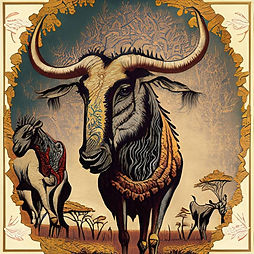
This is an AI Generated Image.
Chimera
Chimeras are two-headed mammals. They have a main body that is much like a lion, and the head of a goat on their back. They have a long serpentine-like tail. While chimeras are mammals, they lay eggs to hatch their young.
Chimeras blow fire, which is biological and not magic. Their fire is not affected by magic-dampening materials like gold and bronze. The fire breath requires the use of their goat-like head and without the head, they cannot breathe the fire.
Chimeras must have both heads killed to be killed, or they must be struck through the heart.
Chimeras originate from the underworld. However, they have been found across all of mainland Materna and Culeparossa.
Chimeras are heavily trafficked as exotic pets. While technically illegal, as they are underworld creatures, chimeras are bred and sold to people desiring loyal and fearsome guard or attack animals.
Chimeras can be tamed and trained by competent people, just like lions, tigers, and other large feline. However, they cannot be fully domesticated to the same extent as dogs. Chimeras have on occasion turned on their masters, but for the most part, do not turn on their masters unless provoked.
The illegal exotic animal trade is largely dominated by lions, tigers, and chimeras. Nemean lions used to dominate the trade as the guard and attack animal of choice, but they are no longer in regular trafficking. This is because of the army's overuse of the nemean lions during the Troisiéme and Quatriéme Wars. This overuse decimated the nemean lion populations. Since the end of the Quatriéme War, chimeras have taken the nemean lion's place as the most popular exotic pet of the rich and small militia groups.
Cockatrice
A cockatrice is a desert creature. It's a flightless bird that lays eggs with a body that is long like a snake (approximately 3-4 feet in length (.91-1.22 m) when adults). The body is feathered. It has rooster-like legs and wings in the middle of its long body. It also has a rooster-like beak, comb, and wattle. It can release an aerosolized toxin from its mouth that temporarily frazzles the nervous system of other animals. This causes other animals to become immobilized for as long as they are under the toxic breath. Cockatrices will swallow their prey whole, and slowly digest them, like a snake.
Weasels and mongooses have a natural immunity to the cockatrice's toxin. They are the common predators of cockatrices.
Cockatrices are native to Sotram and Culeparossa. They have been seen, but are rare, in both Serracolle and Alhamra.

This is an AI Generated Image.
Enfield
An enfield is a type of fox. It's a fox that has hind haunches and a tail more like a wolf and forefeet with opposable thumbs and retractable claws. Enfields have behaviors typical of other foxes. They are extremely clever animals and are good at using their hands to get into things. They are good at short-distance bursts of running for quick escapes. They are able to flatten their body when they fall, in order to land on their feet, and survive falls from great heights, just like felines.
People have been known to domesticate enfields. In order to domesticate enfields, a person must raise them from infancy. Enfields can only be loyal to one person (or a set of multiple persons, if these persons were all involved in raising them from infancy). Ownership cannot be transferred. When the owner/owners is/are deceased, enfields become unruly and will revert back to being feral. Domesticated enfields do not tolerate mistreatment and will attack people if provoked. If provoked by an owner, enfields lose their loyalty and become feral again.
Enfields are native to central Nortram, Dagmar, Gattenwood, and central Croulia.

This is an AI Generated Image.
Ghoul
A ghoul is a nocturnal carnivorous canine that feasts on carrion flesh. It has a hairless hyena-like body and no tail, appearing like a deformed human. Its forefeet have opposable thumbs and claws, that allow it to grab things and dig. It has been known to dig up people's dead bodies to consume. Ghouls can travel either alone or in packs. While ghouls normally consume already dead bodies, they may attack sickly or lone persons or animals, especially when in a pack.
Ghouls should not be interfered with while eating. They are extremely defensive of their food and will attack even larger predators or people if that animal/person interferes with their eating. Ghoul attacks can be particularly dangerous as their mouths and claws contain a lot of bacteria and diseases. Even if a person or animal receives only a minor bite or slash, they will almost certainly die without medical intervention because of disease. The affected may die even with medical intervention. Ghouls can also spit up their stomach bile, which is a corrosive acid that can maim or blind people/animals.
Ghouls are native to northern Nortram, Vestia, and Ostria. Because they are hairless, they hibernate during winter.
Griffin
A griffin is a high mountain bird. It is a rare four-legged bird, with the back feet being paws instead of talons. It has a golden-eagle-like face, wings, tail, and forelegs. Griffins can grow to the size of a lion. Griffins are birds of prey, that typically eat mountain goats and other small to medium-sized animals. They have been known to carry off people too.
Griffins can be domesticated in the same way that falcons are domesticated. They can carry up to 150-250 lbs (68.04-113.40 kg) at a time.
Griffins are native to Rohuroku, Alhamra, western Sotram, and eastern Serracole.

This is an AI Generated Image.
Hellhound
A hellhound is a canine creature that lives in caves. It looks like a wolf with black or dark gray fur which will sometimes have dark red patches. It is known for its red eyes. Hellhounds come in one, two, and three-headed varieties. The one-headed ones get to a height of 2.5-3 ft (.76-.91 m) tall, the two-headed ones get to a height of 3-3.5 ft (.92-1.07 m), and the three-headed ones get to a height of 3.5-4 ft (1.07- 1.22 m) tall. If a hellhound has multiple heads, one has to kill off all its heads for it to be dead or kill the body instead.
Hellhounds are native to Styxa, the Vestian Mountains, and the eastern desert of Sotram.

This is an AI Generated Image.
Manticore
A manticore is a cave-dwelling creature usually found near volcanoes or bottomless holes leading to the underworld. They have dark brown or gray fur that blends in with cave walls. It is about the size of a horse, with a lion-like body and a set of wings. Its face has a flatter face in comparison with actual lions. It has quills coming from its mane, and a large ball of quills at the end of its scorpion-like tail, reminiscent of a mace.
A manticore's quills can be shot at predators and prey, and, much like a porcupine's quills, are difficult to remove once lodged in the skin. These quills can get the skin infected if they remain or are not properly removed. This has led some to believe that manticores are poisonous, but manticore quills are not inherently poisonous. Manticore bites will always lead to infections, but the severity and type of infection vary from manticore to manticore. Some will heal on their own eventually, and some will lead to death if left untreated. It is recommended that bites should be treated as soon as possible, preferably by carving out the affected flesh and then applying a healing spell to restore the flesh. Then either an infection-burning spell should be administered or medicinal herbs taken to ensure that no infection remains in the bloodstream.
While manticores are not impenetrable, they do have relatively thick fur. Knives or arrows sometimes become stuck in the fur and fail to pierce the skin depending on their angle of impact or momentum.

This is an AI Generated Image.
Nemean Lion
Nemean lions are a type of lion that has a near-impenetrable hide. They are larger than other lions and have naturally lighter-colored fur. They have sharp claws that can cut through metal, including breastplates and shields. Nemean lion hides are renowned for their difficulty in penetration. Only plasma blades and other nemean lions' claws can pierce their skin. They also have unusually strong bones. Their bone density is so great that more than four times the force to break their bones as to break the bones of a normal lion. Because of their resistance to blade and impact weapons, they are excruciatingly difficult to kill. They are vulnerable to attacks on the eyes and through the open palate. Poisons, toxins, and fire can also be used to defend from or attack them.
Despite nemean lions' seeming invincibility, they are actually an endangered species. Throughout history, nemean lions have been bred and trained to attack enemy combatants. During the last Quatrieme War, they were so extensively used in battle against the demons, that they eventually became endangered.
Nemean lions are not domesticatable as pets or farm animals but can be trained in a limited capacity (much like regular lions). Their use in battle had mainly been employed by sending them out in advance of the troops, to break up cavalry advances, and to avoid the lions attacking soldiers of the army that sent them. However, they can also fight side by side with soldiers if a trainer is nearby to direct their attacks.
Nemean lions are native to Sotram. There are a few in Culeparossa, Rohuroku, and Alhamra, but they are not in Notram as they are a strictly desert and shrub-lands-dwelling species.

This is an AI Generated Image.
Phoenix
A phoenix is a falcon-like bird with orange, red, and/or gold feathers. Phoenixes possess fire magic and can attack prey and predators with small fireballs that have a ten-foot range. They are also capable of lighting their bodies on fire to attack as well. Phoenixes are also able to use their fire magic to heal their body and wounds. Their saliva can be used to heal small wounds and cure infections. Their saliva can also be used to cure poisons that have entered the body through a particular wound, provided that that poison has not traveled into the rest of the body.
Phoenixes live for forty years. While they can live for a long time, more than half of phoenixes will fail to reach at least thirty-five because of predation and territorial disputes between other phoenixes and birds. They reach maturation at ten and fall out of reproductive years between twenty-five and thirty years. Couples will have between one to three chicks at a time. Chicks must be supported by a parent until they are at least four but are often kept by their parents until they are six or seven years old. Couples cannot have another litter of chicks until their previous litter of chicks has been out of their nest for at least a year. Widowed males or females will not be accepted by a new mate until their previous litter of chicks has been away from them for at least a year.
Phoenixes generally stay away from humans and other people. They typically live either solitary or as couples. Phoenixes establish territories and will attack phoenixes and other birds when there are territorial disputes. However, during two or three weeks of spring, single phoenixes of reproductive age travel to lakes and water holes away from people to search for mates. During this time, they do not attack others of their kind, except if there is competition over a particular mate. Both male phoenixes and female phoenixes may fight others of their same gender to settle disputes over mates, although it is more common with males. Once birds have paired off, they will travel back to the before-claimed territory of the male. Those that do not pair off will return to their previous territory and return the following year to try again. If a phoenix does not find a mate by the time it reaches twenty, it will not receive a mate unless it happens upon the territory of a willing, single phoenix.
It is to be noted that if a person interrupts the mate-selection gathering, phoenixes will scatter and stay in hiding for two to three days. If the person does not leave within the time frame, all the phoenixes will return to their original territory without choosing a mate. Because of this, it is illegal to knowingly interrupt a phoenix mate-selection gathering. Only designated experts who are trained in secret observations are allowed to observe these gatherings.
Phoenixes typically do not support other phoenixes outside of their mate and their young before they reach maturation. If a single female phoenix crosses a single male's territory or vice versa, she will either accept the male as a mate or leave for a new territory as the male will not support a female who is not his mate. The only exception is with female phoenixes. Female phoenixes may partner together in times of winter and famine to stave off male phoenixes from encroaching on their territory. If a female phoenix is widowed with young chicks, another widowed or single female may partner up to temporarily assist her in raising her young. However, these truces only last until spring when mating season comes. Then the females will separate, whether or not they are successful in finding a mate.
Phoenixes generally stay away from people. If a small village or a small number of people live in a region, they are fine with choosing that area as a hunting territory. However, they will not choose hunting grounds where there are extensive populations. Phoenixes can be trained in the same way as falcons, but only if they are raised by a particular person from youth. That phoenix will then bond with that individual and only that individual. The trained phoenix will not mate with other phoenixes. If that individual dies the phoenix will return to the wild to live as any other phoenix, including accepting mates if they are still of reproductive age.
Phoenixes are native to Sotram and southern Nortram. However, they have been seen as far north as Vestia and Ostria, and as far west as central Croulia.

This is an AI Generated Image.

This is an AI Generated Image.
Questing Beast
A questing beast is an unholy hybrid between two unlikely creatures either mammalian or reptilian parentage, and therefore can take various forms depending on the parents. It occurs when two animals of different species (one male, the other female) mate on the night of the Tvillinger. Questing beasts differ from typical hybrid creatures, as their creations can only take place on the night of a Tvillinger. For example, a mule results from a horse and a donkey breeding. Horses and donkeys, while different species are more closely related creatures. They can reproduce together, even if their mating is not on the night of a Tvillinger. A questing beast, on the other hand, might have their parentage as a bear and a goat, or a leopard and a camel, or a snake and a salamander. These unions would not produce offspring, except on the night of the Tvillinger.
Questing beasts are infertile creatures and cannot reproduce, even if they mate with another animal on the Tvillinger. They are typically shunned socially from other creatures, even those of one of their parent's species. Their solitary lives will either lead them to be unnaturally shy or unnaturally aggressive.
Because of the strange nature of the questing beast, some nobles have set experiments to create new varieties. Unlikely animals are typically hesitant to mate, making the practice fall out of interest after a few years whenever the trend occurs. It is not uncommon for animals and their offspring to die when pregnant with a questing beast. Questing beasts also do not always come out the same, even if they have the same parents.
It is to be noted, that questing beasts can only result from two non-sentient mammals or two non-sentient lizards. Questing beasts cannot result from birds, fish, insects, etc. They also have not been created when using individuals of sentient races. Numerous experiments have attempted to create questing beasts with sentient races, as some have hypothesized that this is how new breeds of sentient races have occurred. However, such experiments have failed to produce any pregnancies, successful or otherwise. Many have also tried mating two sentient races that cannot produce pregnancies, such as dwarves and elves, and have failed to produce pregnancies as well.
The purposeful creation of a questing beast is seen as unholy by the goddess Hlathanna. As she is the goddess of motherhood and childbirth, utilizing a woman's fertility for a purpose other than its intended purpose, such as gross curiosity, child sacrifice, abortion fetish, or disassembly and use of the child's parts for magic or medicine is all considered an affront to the goddess's sacred gift of childbirth. Therefore the deliberate attempt to create questing beast life is blasphemous. According to her laws, any questing beast is considered unholy, and therefore cannot be allowed on the grounds of her temples or monasteries.
Rasselbock
A rasselbock is a carnivorous animal with a rabbit-like body, fangs, and antlers. Rasselbocks hunt animals, mainly lizards, amphibians, and rodents, of similar and smaller sizes. They are only aggressive towards larger animals when threatened, and sometimes during mating season. They have been known to try and attack babies and toddlers when left unattended. Rasselbocks usually hunt alone, but can sometimes hunt in small packs.
Rasselbocks are native to Vestia and northern Nortram.

This is an AI Generated Image.
Simurgh
A simurgh is a large carnivorous avian creature, much like an enormous eagle, only with a snout and teeth instead of a beak. The simurgh can grow to have a wingspan between 15 to 20 feet. It is a bird of prey capable of carrying goats, deer, and even wild cats off as food. Simurghs either hunt smaller cattle alone while their mate sits on the eggs or hunt in pairs for larger prey.
Simurghs are native to Rohuroku and Alhamra. A few have been found as far north as the Vestian mountains. They live exclusively in the mountains, where they build their nests on ledges to prevent predators from attacking their eggs. Their biggest predator is the sphinx.
Sphinx
A sphinx is a type of winged lion. It has a wingspan of 10 to 12 feet. Sphinxes have the typical habits and sociality of regular lions, living in packs, with the females often hunting in groups.
While they are troublesome, dangerous, and eat a lot of cattle, the packs of females are also known for hunting down and killing large predators and monsters. Sphinxes are known to hunt regular lions, hyenas, simurghs, catoblepasses, griffins, and even wyverns. Because of this locals usually leave sphinxes alone, unless they start hunting people or become a nuisance.
Sphinxes are native to Rohuroku and Sotram.

This is an AI Generated Image.

This is an AI Generated Image.
Tarasque
A tarasque is a feline creature with a spiked shell like an armadillo. Tarasques have a noxious breath that puts people and other animals to sleep or sometimes causes death. Tarasques have six feet, and range from the size of a bobcat to the size of a cow. They are not as fast as typical cats, traveling not much faster than a person walking. However, they are good at swimming and digging into the earth.
Tarasques hunt by spewing their toxic fumes to incapacitate their prey. If their prey is in the trees, they stand under their prey until the prey falls and breaks their body on their shell. If their prey is underground or in caves, their extra set of feet allows them to rapidly dig creatures out. They will also sometimes swim in rivers and lakes and then use their shells to bash creatures, people, or boats floating on the top of the water.
Tarasques are native to Croulia along the Chardor River and Gattenwood.

This is an AI Generated Image.
Tatzelwurm
A tatzelwurm is a carnivorous feline-like creature with a long extended neck and tail, both as long as the main portion of its body. Tatzelwurms range from 10 to 15 feet in length from their head to the tip of its tail. They are slim though, with their bodies being only one and a half to two feet wide. Because of their slim bodies, they can fit into holes and caves easily. Tatzelwurms have a poisonous bite and can release a high-pitched screeching sound that is irritating to people and other creatures.
Tatzelwurms are solitary creatures, except during mating season.
Tatzelwurms are native to northern Croulia, Vestia, northern Nortram, and Ostria.
Vampire
Vampire-bats are a type of blood-sucking bat-like creature. Vampire-bats have eyes larger than typical bats, relying on their eyes to see, instead of echolocation. They also have extra long fangs to facilitate blood-sucking. They range in size from a 1 to 3-foot wingspan. The larger the vampire, the larger the prey it will attack. Vampire-bats will drink anywhere from 2 to 6 liters of blood depending on their size and the frequency of their hunts. After eating, they will retire to their caves to sleep.
Vampires-bats avoid fire, sunlight, and bright reflective objects, as their large, sensitive eyes are hurt by light. If exposed too much to bright light, especially at a close distance, their eyes can become temporarily damaged and may become blind. If a vampire-bat is blinded, whether permanently or temporarily, it is no longer capable of hunting or flying. This leads to vampires-bats dying.
At night, vampire-bats can be avoided by staying within enclosed structures or tents.
Vampires-bats are frequently carriers of diseases. If a diseased person is bitten, the disease can spread to every subsequent person bitten within a week. While rare, vampire-bats can also pass certain other diseases to people, like rabies and vampirism. Vampirism can only affect humans, elves, fae, and other species that are not hybrid with animals. The only exception is dryads, as dryads are resistant to most diseases.
Vampirism is a disease that causes temporary coma, followed by an awakening to an almost insatiable desire to consume blood like a vampire. This insatiable lust leads to violent madness in the pursuit of this desire. Those infected with vampirism are also called vampires. Vampirism is a deadly disease and, much like rabies, has an inevitable death soon after infection. Many infected people die during the coma phase of the illness. However, those that go on to rampage as "vampires," can infect other people by simply biting them, making the disease highly dangerous. They have yet to discover a cure for this disease, but infection can be prevented if the bite occurs on an appendage that is chopped off within an hour of being bitten.
While vampirism almost inevitably leads to death, there have been rare instances of people living semi-normal lives infected with vampirism. Those rare exceptions that fall into this category do not exhibit an insatiable blood lust, but instead a persistent hunger. Because of this, they do not develop madness and are capable of maintaining self-control. They will pass on the disease, however, if they bite or copulate with someone of a species susceptible to vampirism. Those infected with vampirism are sensitive to sunlight and other bright lights, but not to the same extent as a vampire-bat. They are not sensitive to firelight and other dimmer sources of light.
Vampire-bats are found all over mainland Materna but are more concentrated near areas around mountains with greater access to caves. Vampire-bats are typically not found around cities because of the night-time lights and fires.

This is an AI Generated Image.

This is an AI Generated Image.
Will-o-wisp
A wisp is a nocturnal deep forest and swamp-dwelling flying amphibian. It has a body that looks like an axolotl without a tail. They come in light blue, light green, rose pink, light purple, and white colors, and are translucent. They are relatively small, ranging from an inch to six inches in length. Wisps are insectivores and do not present a danger to people.
Wisps can absorb magic from the environment. This ability allows them to fly and create plasma energy barriers to protect them from predators. When absorbing or sensing magic, they will glow, appearing to casual passers-by as lights.
Wisps are drawn to areas that have strong natural sources of magic. Because of magic derived from the moons, they are most active on nights when there is a full moon, especially when there is a Tvillinger. They use these times to engage in mating rituals. Wisps lay their eggs in sources of water, where the eggs hatch into tadpoles. These tadpoles eventually grow into wisps. Wisps are incapable of absorbing or using magic until they are adults.
Because of wisps' definitive attachment to magic sources, they are often associated with the gods and goddesses as well as the supernatural. Wisps are sometimes drawn to people in extreme emotional states, and this can be seen as a sign from the gods/goddesses, or of fate in general.
Wisps are found throughout mainland Materna but only appear in the swamp and deep forest nearby sources of water.
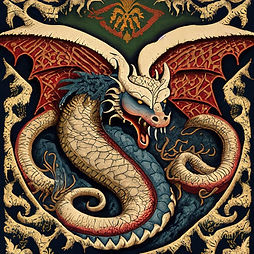
This is an AI Generated Image.
Wyvern
A wyvern is a flying reptile. It is similar to a dragon, only it has only two legs, and it does not grow to the same size. Wyverns only grow to a maximum of twenty feet in length. Wyverns only have two legs, which are angled similarly to birds to support a more upright sitting position.
Wyverns, male and female, can blow noxious fumes. Male wyverns can also blow fire. However, unlike dragons, this is a biological rather than magical ability. The fumes and flames they spew are not affected by the magical blocking abilities of gold or tin.
Wyverns have a lifespan of 25 to 30 years. They are found in southern Nortram, Sotram, Gattenwood, Rohuroku, and Serracole.
Ypotryll
A ypotryll has a boar-like head with tusks, hooved feet, and humps on its back like a camel. Its tail is long, and has the ability to grasp objects, much like the body of a snake. Their tails are very dexterous, able to even perform fine motor skills. Ypotrylls have been used as beasts of burden, though this is not as common because of their unagreeable nature, and ability to unlock gates and undo knots with their tails.
Ypotrylls are found in southern Nortram, Sotram, Gattenwood, and Culeparossa.