


Sea Beasts
Hippocampus
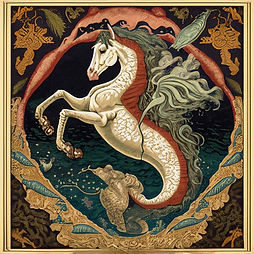
A hippocampus is an aquatic horse. They are mammalian. They have fins instead of legs, and a long, dolphin-like tail. They have a blow hole on their back from which they can breathe and can hold their breath for a half hour. Hippocampuses behave similarly to their land counterparts, and merfolk use them functionally in the same way. Hippocampuses are not as common and widespread as regular horses.
This is an AI Generated Image.
Hydra
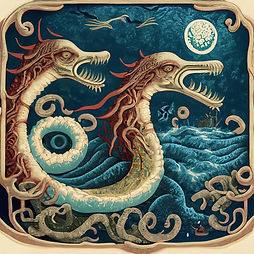
Hydras are multi-headed, eel-like monsters. They can have anywhere from three to nine heads. They start out about three to four feet in length, but will continually grow larger, with no known largest size. Their bite is poisonous.
Hydras are native to the northern sea.
Kraken
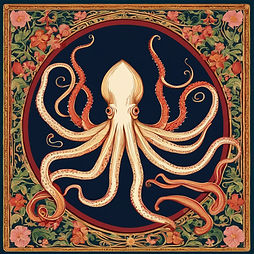
Krakens are giant squid-like monsters. When they hatch, they are relatively small, only about four to six inches in length. They grow exceptionally quickly at first, reaching a size of a hundred feet in length by the time they reach four years (point of maturation). Afterwards, their growth slows to the rate of ten feet a year. They will continue to grow each year until they die at about twenty-five to thirty years of age.
Krakens are carnivorous. While many tales of krakens focus on larger krakens attacking boats or cities of merfolk/sirens, larger krakens are not typically overly aggressive. Krakens are most aggressive during their growth spurt years when they are most in need of nutrients.
Krakens are native to the northern and eastern oceans.
It is to be noted that krakens rarely make it to lengths of two hundred feet or greater. Krakens often do not even reach the point of maturation. This is because krakens will attack and consume other krakens when they encroach on their hunting grounds. Larger krakens are also more apt to receive injuries from normal activities because of the sheer volume and length their body takes up. When they get injured, smaller krakens will temporarily gang up on them and kill and eat them to take over their territory.
This is an AI Generated Image.
This is an AI Generated Image.
Sea Goat
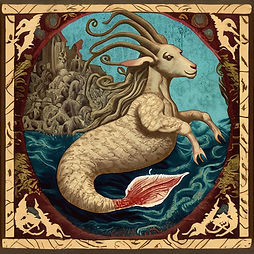
A sea goat is an aquatic goat. They are mammalian. They do not have any rear legs and have fins instead of front legs. They also have a long, dolphin-like tail. They have a blow hole on their back from which they can breathe and can hold their breath for a half hour. Sea goats behave similarly to their land counterparts, and merfolk milk them and use them functionally in the same way. Sea goats are cultivated in merfolk and sirens and are fairly common in their villages, cities, and territory.
Merfolk use their milk to drink and make cheese. They retain the milk for consumption and cheese-making in fish and other aquatic creatures' stomachs and air bladders. They dry the stomachs and air bladders out on rocks in the open air, and they take them back into the ocean for use in capturing milk that they get from sea goats (and sometimes hippocampusses, seals, whales, and dolphins as well).
This is an AI Generated Image.
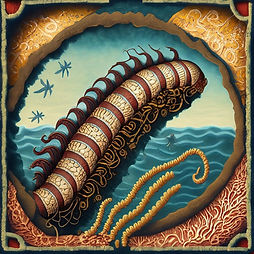
Skolopendra
Skolopendras are large sea monsters that are arthropods. Like millipedes, they have many legs that function as rowing mechanisms. They have two pincers at their head to eat and attack things. Its head is lizard-like and has catfish-like whiskers. Its tail at the end is lobster-like, curving upwards.
Skolopendras start relatively small, only being about three feet long when they reach adulthood at the age of one. However, skolopendras will continuously grow, year after year until they die. Because of this, some skolopendras can get quite large, with a few recorded as being at lengths of thirty feet.
Skolopendras are native to the western and southern oceans.
This is an AI Generated Image.