


Edderkopfolk
Spider-people: Drommegulper and Holeboer
Spider-people or edderkopfolk were developed about fifty years before the Break-Through in the Lower Kiorje mountain region. The edderkopfolk began spreading and repopulating rapidly and wiped out entire villages. Larger villages, however, began to develop abilities to defend against the edderkopfolk. This created a barrier to the spread of the edderkopfolk, as it limited their geographic boundaries. It also limited their population growth, as they began to cannibalize each other for food. Some Sedderkopfolk were able to escape into the general population. Some edderkopfolk have been integrated into normal society as executioners or enforcers, in order to give them a steady diet of bodies to suck. Even when integrated into regular society, they are antisocial, do not respect typical conventions of personal space and privacy, and will often find ways to continue consuming people in private without societal approval.
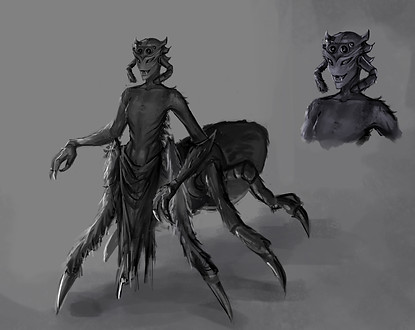
Spider-people can consume juices or nectars as a source of energy, in addition to blood and liquified organs as a source of food.
Spider-people are inherently untrusting of their own people. The edderkopfolk will cannibalize even those related to them when they feel that their territory is threatened. Edderkopfolk, in general, will cannibalize other Spider-people when they fear that their territory, life, or food supply is in jeopardy by another spider-person. Because of this phenomenon, the edderkopfolk are a rather small population. Experts estimate that less than a thousand Spider-people exist at any given time.
There are two kinds of spider-people: huleboer and drommegulper. Both kinds of Spider-people have eight legs, eight eyes, fangs, and a spinneret that comes from their buttocks area. Both have their pedipalps located on the sides of their head, just below their ear holes. Both species have human mouths with human tongues, in order to talk like humans. Each has a larger central set of eyes, with a smaller pair on top of the head. The remaining eyes are smaller and grouped under their central eyes. Both spin webs.
They have a strong set of first legs, that they walk on along with their fourth set of legs. They also heavily rely on both sets of legs when climbing. The second and third sets of legs are mostly meant for stabilization when climbing. While they do not have hands, the tips of their leg can curl slightly around objects. They usually use both second and third legs in tandem to perform fine motor functions, such as writing. They do not typically wear clothes.
Huleboers will typically find holes as a means of entrapment. They come in grey, brown, and yellow. They are longer hairs and have matted coloring. They do not have spores in their webs.
Drommegulpers have more glossy, spider-like skin tones, such as black, blackish blue, and grey. They have shorter hairs all over their body. Dream-eaters weave their webs in trees above where people can see them. Their webs contain spores that make people sleepy and can incapacitate people. Individuals can overcome the effects of the spores through regular exposure.
Female edderkopfolk can only get pregnant once a year, and they can only have a pregnancy once every two or three years. While not typically friendly with other spider-people, during mating season, they are more sociable. Males are expected to bring a gift of food for the female, wrapped up in webs. After the event, the female devours the gift of food. If there is no food, or the food is deemed not sufficient, the female devours the male. Females require a large amount of food shortly after impregnation in order to maintain their pregnancy, otherwise, they miscarry. Males do not typically stay with a female past the initial mating. If a female carries to term, she typically delivers between 7 to 12 babies. Babies stay with their mothers for about three to four years before they are turned out. Spider-people typically do not maintain family relationships past upbringing, as food territories are often scarce. Both males and females will devour children that get in their way. Spider-people reach full maturation at about six years. Their total lifespan is 30 to 35 years.
Edderkopfolk are only capable of reproducing offspring with other edderkopfolk. They can, however, mate with other races, but this will not produce offspring.
When drommegulpers and huleboers mate with each other, they have a fifty-percent chance of producing one or the other species. Drommegulpers and huleboers typically do not mate with each other if a viable alternative of their own kind is available.