


Solstefar

Solstefar (SOL-steh-FAHR) is the god of the sun, justice, wisdom, foresight, knowledge, and fatherhood. He is known for being patient, level-headed, and fair. He created the harpies and the asterian race. He is revered by all diurnal races. His festival is the Summer Solstice. The month Solsman is named after him.

Temple of Solstefar

Temple of Solstefar
Temple of Solstefar
Temple of Solstefar
This is an AI Generated Image.
His Temples
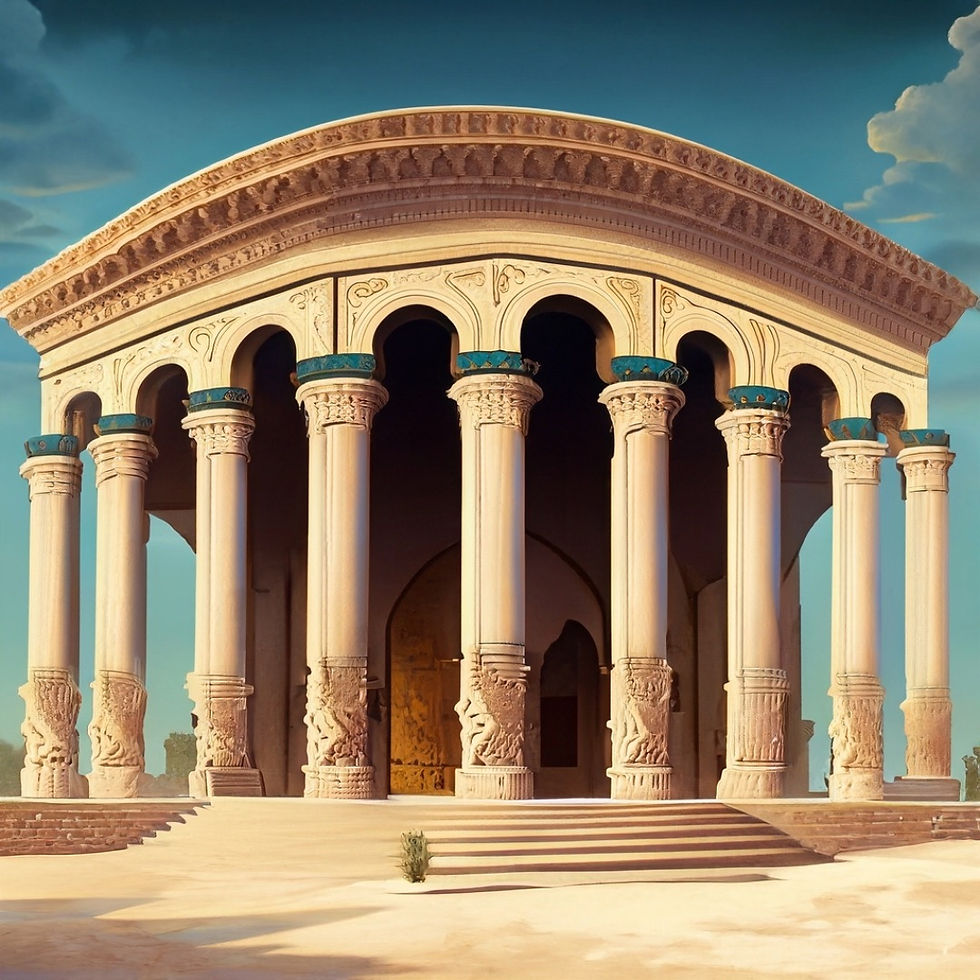
The temples of Solstefar are known for their white, cream, and light-sandy-colored building materials. They are also known for their flat or low-pitched roofs, and the tall pillars lining the front of their buildings.
Temples will have an atrium in the interior that lets in ample sunlight. They will often feature rock or sand gardens, as well as a prime location for harvesting solstens on the height of the summer solstace.
Worship
Temples to Solstefar feature pillars that symbolically point upwards to the sun. They also have either an open-air atrium or an atrium with one or more large stained glass windows to let the sunlight into the temple. The atrium will feature a sundial that shows the time at either the head or center of the room. It will also have several pews for worshippers to sit and look at the sun or the sundial. Worshippers often light candles and incense and then pray quietly in the atrium of the temple.
At home, devotees will worship Solstefar by praying either when the sun goes down or rises, or sometimes both. Worshippers will pray in the direction of the sun.
Worship of Solstefar is prevalent among all communities that are diurnal. Groups and lands that are devotees of the god are Alhamra, Rohuroku, and among asterians and harpies. Devotee communities are also found in Culeparossa, Sotram, and Serracolle.
Even among individuals that are not devotees to the god Solstefar, many people will go to the temple of Solstefar for the naming ritual. Worshippers of Hlathanna may even go to both a naming ritual of Hlathanna and the naming ritual of Solstefar.
Sacred
Solstefar holds certain objects and rituals as sacred to him, and devotees of Solstefar, therefore, hold these things sacred as well.
1. Fatherhood: In houses devoted to Solstefar, the father is always the head of the household. Fathers are expected to stay and take care of their children, and children are supposed to be obedient to their parents, especially their fathers.
2. Fair Trials and Laws: Followers of Solstefar cannot give people unequal treatment in court based on status, wealth, species, popularity, beliefs, charisma, intelligence, perceived crimes, or lack thereof. They are not particular about how the trials are conducted, as long as all people get equal treatment before the law. It is to be noted that they are not against laws that affect one group explicitly or implicitly more than others, as long as the application of that law is consistent and does not change on an individual basis.
3. Education: Receiving a good education is considered a sacred responsibility that parents are responsible for giving all their children (both their sons, as well as their daughters and regardless of the marital status or lack thereof between the parents). While parents are not expected to give their children educations they cannot afford, they are responsible to give their children the best education within their reasonable power.
Blasphemy
Solstefar holds certain practices as blasphemous to him, and devotees of Solstefar, therefore, hold these things as blasphemous as well. Those who commit blasphemy against Solstefar without seeking forgiveness or absolution may be cursed with blindness as they journey to the land of the dead or for a certain period after entering. They may also be cursed with either forgetting their name or forgetting the names of their loved ones and friends. In extreme circumstances, Solstefar will take away their name in the afterlife. Those whose names are taken away from them will never remember those they knew in life, even if reminded.
1. Giving a Child a Last Name Other Than the Father's: Because fatherhood is sacred to the god, giving a child a last name other than their father's last name is considered a spite against fatherhood, as well as blasphemous to the god Solstefar. Because of this, infidelity in marriage, or excessive promiscuity before marriage for women is considered disrespectful to Solstefar. This is because these behaviors might call the paternity of their children into question and therefore contribute to their children having a different last name than their actual father. As a result, women in communities that are devoted to Solstefar a usually virgins when they are first married.
2. Tyrannical Laws: A government is considered to have committed blasphemy against Solstefar if they have created laws that unreasonably intrude on a person's ability to be a parent or raise their children. Because of this, countries cannot pass laws that forbid or make it unreasonably difficult for people to work and earn money or the necessary provisions to feed, clothe, shelter, protect, and educate their families. Countries also cannot pass laws to force women to have abortions as this is blasphemous to Solstefar (as well as Hlathanna). Communities devoted to Solstefar might either outright ban abortion or require that a woman get permission from the father of the child before she obtains one, as it is considered an inhibition of a man's right to be a father (obviously this does not include a pregnancy that is fatal to the woman, as being dead inhibits her ability to be a mother).
3. Disrespecting One's Parents: Children are expected to be obedient to their parents (obviously within reason. Children are not expected to do things that are physically detrimental to them, against the law or Solstefar's laws, or reasonably inhibit their own future ability to become parents themselves). Once children are adults, while they are not expected to follow their parent's every command, they are still expected to treat them with respect and deference.
Rituals
Solstefar has four sacred rituals that all devotees must perform: The Naming, The Pledging, Marriage, and The Release of the Dust.
1. The Naming: Within a year of when a child is born, the parents must travel to the temple of Solstefar to proclaim their child's name. The ritual takes place at sunrise. The ritual starts with the mother holding the child. The parents will present their baby to the priest, who then anoints the child's head with sacred oil. The priest will then ask the parents what the child's name is, and the parents respond in unison with the name of the child (it is noted that the parents must give the same name or else the ritual will be halted and possibly postponed until the parents agree on a name). The priest will then take the child, raise the child up in the light of the rising sun, and declare the child's name before Solstefar. The priest then blesses the child to flourish under the protection and direction of his or her parents, to grow and become a parent as well, and to always find the light of the sun and of Solstefar. The priest then returns the child to the parents, specifically giving the child to the father to hold.
2. The Pledging: Between the ages of fifteen and twenty, the parents take their children to the temple of Solstefar to present them as adults. The priest then anoints the child with the holy oil. The child pledges to devote their name to the god, placing a stick or rod with their name engraved on it on the altar of Solstefar. This is done during the time of day when the sun's light falls upon the altar. The sun's flames then set the stick on fire until it turns to dust; alternatively, the sun melts the rod until it oozes off the altar as liquid. The priest then anoints the child with the holy oil. The priest then pronounces adulthood upon the child and blesses them to flourish under the protection and direction of Solstefar as they step into adulthood and find their own path in life. He commands the child to never forget their parents and to always look to the light of Solstefar. Upon command, the child arises, now an adult.
3. Marriage: With marriage, instead of giving the man his daughter's "hand in marriage," the father gives the husband the right for the woman to take the husband's name instead of the father's name in marriage. It is considered disrespectful to Solstefar for a woman to refuse to take on her husband's name when getting married.
For the marriage ceremony, the man stands by an altar with a rope. The bride comes up to the altar with her father (or her closest male relative who bears her same last name. If there are no living male relatives with the same last name, a female relative with the same last name can be used. If there are no relatives with the same last name, the bride will carry an oversized goblet with the emblem of the sun emblazed on it to represent the god.) The bride has a rope binding her to her father as they come to the altar.
The bride and her father kneel at the altar in front of the priest. The priest asks why they have come. The bride says that she wishes to take a new name. The priest asks her what new name she would like to take. She says that she wishes to take the name of her husband. The priest asks who she would like to take as her husband, indicating that she will have to help him carry his name forward in work and the community and for future generations. She acknowledges the responsibility and speaks her fiance's name. The priest asks him to step forward. The man steps forward, declaring that he is present. The priest asks if he would be willing to allow the woman to take upon his name as his wife. The priest says that in taking on his name as his wife he will have a charge to care for, support, and protect her as part of himself. The man says that as his wife, she may take on his name, and acknowledges the responsibility involved. The priest turns to the father, asking if he is willing to allow the bride to take the fiance's name in place of his own. The father gives his permission. The priest then takes a ceremonial dagger and cuts the bride from her father. The priest asks the fiance to take his place. The father arises. The fiance takes his place at the altar. The priest then repeats the responsibilities associated with marriage. The couple reaffirms their willingness to follow these responsibilities. The priest then binds the couple's hands together. He has the couple arise and he then declares their marriage and the bride's new name.
4. The Release of the Dust: The priest, the main family, and any other funeral participants will each write the name of the deceased on individual pieces of parchment paper. They will then set the paper on fire and place the burning papers one by one on the altar (or on the funeral pyre if the deceased is being cremated). Once the papers (and the body too if the deceased is being cremated) are turned to dust, the priest will sweep the dust into a vase or urn. He will then take the dust and disperse it over the final resting place of the body while requesting that Solstefar allow the deceased to carry their name on to the land of the dead, so their memory of their life and loved ones will remain with them in death. The onlookers will then, in unison, pray that Solstefar will let the deceased keep their name so they can remember them in death in preparation for the time they will meet again.
Summer Solstice Festival
The Summer Solstice Festival is dedicated to the god Solstefar. It starts Manday, the 9th of the month Solsman, which occurs around our version of June 20 or 21. It lasts three days (like every festival), but often festivities will continue all week long.
The Summer Solstice is one of the biggest celebrations of the year (only the Spring Festival and Winter Solstice come close in popularity). Priests of Solstefar harvest solstens prior to and during the festival. A pole is erected around which people will dance, and stay up until the sun sets. When the sun sets, a bonfire is lit, and the priests of Solstefar produce bursts of colored light using sun magic, called 'Solflores.' People dance around the bonfire and watch the Solflores light the sky. On the middle day of the festival, people will often stay up all night long, until the morning (the Summer Solstice Festival is the only three days a year that the curfew is not enforced).
Races are also held during the day for the festival. Races can be foot, horse, or chariot races. Aquatic species will have swimming races. Many people will come and view these races for entertainment. Larger cities, like Chardor, will have arenas where people can view the races.
During the festival, women will often wear flowers. Children will also make flower chains and crowns. Then the children dance around a pole with multiple ribbons tied to it. Children hold onto the ribbons and dance around in a circle. Races for children are also held.
Clergy
Solstefar has only priests, not priestesses. His priests are allowed to marry, and their wives are called priestesses, but the wives serve no religious function. Each temple/monastery will have one to three high priests, with an archpriest over a larger region. Archpriests may travel around with some priests or temple attendants to help with official functions. Arch and high priests will have residences for themselves and their families at the temple/monastery, with a guest residence for visiting priests. Priests will have residences at the temple/monastery as space permits, otherwise, they will have residences at secondary locations dedicated to Solstefar.
Priests are generally chosen out of generational families, though they are sometimes chosen out of temple attendant families or monks. Priests start out as apprentices for a period of at least seven years before they can become novitiate for three years, and then a priest.
Temple/monastery workers will be comprised of priests in training, along with families who serve as generational temple attendants or from the families of monks. Temple attendants have four levels: trainee, general attendant, senior attendant, and priest adjunct. Temple attendants and their families do not live on the temple premises
Monks are people from the general population who devote their lives to Solstefar by leaving their former lives and joining a monastery. People must spend at least three years living at the monastery as a "pledge" before they can say their vows to become a monk. Monks come in four ranks: apprentice, journeyman, master, and temple guard.
Rank increases in priests, attendants, or monks are done through a ceremony.
Solstefar grants his clergymen powers according to their position. General temple attendants, journeyman monks, and third-year priest apprentices receive a quarter portion (a portion being the normal amount of magic for a person naturally holding magic) of sun magic. Novitiates and senior attendants, receive a half portion. Priests, priest adjuncts, temple guards, and masters receive a full portion. High priests receive a double portion. Archpriests and the Oracle receive two and a half portions. These portions are in addition to whatever magic they might naturally possess. Wives receive half the portion of magic their husbands are given. All levels of priests, temple attendants, monks, and their wives are given the ability to know what time it is precisely.
In addition to sun magic, novitiates (and all higher levels), masters, temple guards, and their wives are also given superior sight. This allows them to see twice as far and with twice the detail of the normal elf eye. High priests, arch-priests, masters, temple guards, and their wives are also given hindsight, allowing them to sense the area behind them or the area around them without looking. Priests (and all higher levels) can curse people with sunburns. The sunburns can range in severity, depending on the declaration, but will heal with the natural healing process of the body. They can also curse people with blindness. That blindness might last a certain length, depending on the curse, or require the cursed to do a task to receive their sight. However, healers have found a way to work around blindness curses, by gouging out the cursed's eyes and then regrowing them.
Oracle
Solstefar appoints one of his priests to be an Oracle at a time. This priest must be an asterian (sun fae). This Oracle must personally cut out his own eyes, and then replace them with solstens. Solstefar then blesses him with the "eyes of the gods," allowing him to see all things, past, present, and future. He, of course, may only concentrate on a few visions at a time, so is not necessarily omniscient. He may not magically regenerate his eyes, or he loses his foresight and position as the oracle.
The Oracle has the charge to answer people's questions, whether or not the Oracle personally likes them, and even if the asker wishes the Oracle, his family, the priests of Solstefar, or any other group of people harm. For example, if someone asks the Oracle how he could successfully kill his wife and get away with it, the Oracle would be compelled to answer.
The Oracle can, however, give more or less specificity, depending on how he feels about the individual. For example, for the question about how to successfully kill one's wife and get away with it, the Oracle might answer that the asker must kill his wife when she is out gathering firewood with his neighbor's axe, and then return the axe to the neighbor's woodshed. Then the Oracle might omit the fact that the asker must wait until after the neighbor's in-laws leave to visit their other children for the holidays, or else the asker's neighbor will have an alibi for the time of the murder. That is an example of the Oracle using less specificity to sabotage the answer to a question.
The Oracle could also take advantage of the syntax to lead the asker astray, for example, if the asker wants to kill his wife because he wants to marry another woman with whom he's conducting an extramarital affair, the Oracle might tell him how he could get away with killing the woman he plans on marrying, once they are married, instead of his current wife. This is because the asker did not specify that it was his current wife that he wanted to kill and successfully get away with killing.
The Oracle is allowed to answer one question per person. People cannot get around this rule, even if they try to have someone else ask another question for them. The Oracle will know their intention and refuse to answer. The Oracle can sometimes work around this rule though, by telling someone who can answer their question. He must do this before they ask the question, or it counts as the answer to their question. This behavior though is very rare, and the Oracle only does this if the second question the person might ask will benefit the oracle himself or the cause of Solstefar. The Oracle can sometimes tell people about future events without being prompted, but only if the knowledge will protect the Oracle or let the Oracle meet someone whom he wants to meet.
The Oracle can reveal the answer to someone else's question, only as the answer to another person's question. However, if the asker wants other people to be present to hear the question, that can be allowed if the Oracle approves that desire.
It is to be noted that not every question is counted as a person's "one question." Conversational questions like "How are you doing?" or "What are your favorite hobbies?" or "Is it okay to ask my question now?" are not counted. Only questions that require the Oracle's "vision of the gods" can be counted as questions. The only exception to this rule is if the Oracle explicitly informs a person that the next question they ask him will be their "one question."