


Festivals
This is an AI Generated Image.
This is an AI Generated Image.
This is an AI Generated Image.

This is an AI Generated Image.

This is an AI Generated Image.

This is an AI Generated Image.

This is an AI Generated Image.
This is an AI Generated Image.

This is an AI Generated Image.
Spring (Equinox) Festival
The Spring Festival is dedicated to the goddess Hlathanna. It starts Manday, the 9th of the month Hladith, which occurs around our version of March 20 or 21. It lasts three days (like every festival), though festivities sometimes last all week long, especially in areas populated by devotees of the goddess Hlathanna. Traditionally, farmers will plow their fields prior to the festival and begin planting following the festival, though this is also dependent on the region.
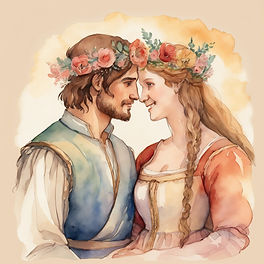
The Spring Festival is generally considered the most romantic festival of the year, and many people will marry during the festival. Married couples are expected to copulate at least once during the week of the festival to encourage the plants to reproduce, and to ensure the fertility of their crops and trees.
The local barony/county will typically make a public spectacle of the required copulation, having the local baron/count and baronness/countess copulate on a bed on a stage, with only a curtain for privacy. Usually only certain groups will be allowed to observe the curtained bed at this time as witnesses. However some baronies/counties will allow any person of legal age to come watch the curtained bed when the act takes place. Other baronies/counties only have the baron/count and baroness/countess preform a public kiss and then retire to their castle together to be undisturbed for an hour to privately conjugate without making a spectacle. The king/queen of each country will also preform the ceremony, but only do the public kiss version. It is said that if the nobility do not copulate with their spouses during this week, it will bring a bad crop to all the land that falls under their jurisdiction. The ceremony is to ensure the public that any crop failures will not be the fault of the nobility. Some regions are less serious about these superstitions, however the nobility kissing and/or copulation ceremonies are still performed for the sake of tradition.
Children have a more toned down version of the festival, the adults instead focusing on the need for couples to kiss just as flowers need to kiss. Children will often follow couples pressing two flower heads together. The couple is supposed to kiss in response. This teaches the children the spirit of the holiday, as well as remind the couples of their responsibility to copulate to ensure the fertility of the crops and trees. Parents will also take the children and show them the borders of their farms, in order to ensure boundaries between properties are remembered from generation to generation.
It is to be noted that the required copulation is stipulated only for married couples. However, some unmarried couples also copulate in the spirit of the holiday.
Rain Festival
The Rain Festival is dedicated to the goddess Sharana. It starts Manday, the 9th of the month Sharandith, which occurs around our version of April 20 or 21. It lasts three days (like every festival). Traditionally, farmers will have finished planting their fields prior to the festival, though this is also dependent on the region.
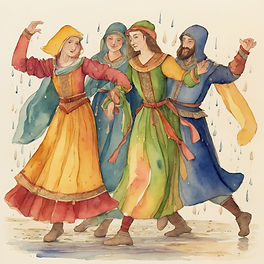
The Rain Festival is meant to call rain on the newly planted crops to help them grow and flourish. Every day of the festival, each third hour of the day from sunrise to sunset (6 am to 6 pm), the priests and priestesses will preform a prayer, ushering in more clouds using water magic. On the final day of the festival, for the sunset prayer (6 pm), the priests and priestesses will construct a human tower, and call for rain using prayer and water magic, while attendents dance around the tower. Following the prayer, a great rain will begin.
During the festival, ordinary people will wear bright colors and some will even paint their hands or faces. The colorful clothing is to symbolize the rainbows that appear after rain (priests and priestesses of Sharana typically wear multi-colored robes for similar reasons). Governments and nobility will typically hang rainbow colored banners for these festivals.
Festivities involving making similar human towers are done by children or youth. Traditionally, once the rain of the festival starts, people will go home and say a household prayer to thank the goddess for the rain. If someone is in a house other than their home, traditionally they will take part in that household's prayer, and remain there until the rain subsides, even if it takes more than one day.
Summer Solstice Festival
The Summer Solstice Festival is dedicated to the god Solstefar. It starts Manday, the 9th of the month Solsman, which occurs around our version of June 20 or 21. It lasts three days (like every festival), but often festivities will continue all week long.
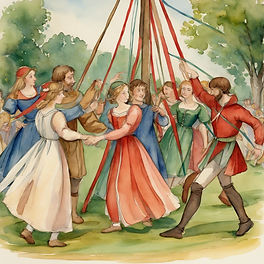
The Summer Solstice is one of the biggest celebrations of the year (only the Spring Festival and Winter Solstice come close in popularity). Priests of Solstefar harvest solstens prior to and during the festival. A maypole is erected around which people will dance, and stay up until the sun sets. When the sun sets, a bonfire is lit, and the priests of Solstefar produce bursts of colored light using sun magic, called 'Solflores.' People dance around the bonfire and watch the Solflores light the sky. On the middle day of the festival, people will often stay up all night long, until the morning (the Summer Solstice Festival is the only three days a year that the curfew is not enforced).
Races are also held during the day for the festival. Races can be foot, horse, or chariot races. Aquatic species will have swimming races. Many people will come and view these races for entertainment. Larger cities, like Chardor, will have arenas where people can view the races.
During the festival, women will often wear flowers. Children will also make flower chains and crowns. Then the children dance around a pole with multiple ribbons tied to it. Children hold onto the ribbons and dance around in a circle. Races for children are also held.
Lightning Festival
The Lightning Festival is dedicated to the goddess Strigha. It starts Manday, the 9th of the month Straiman, which occurs around our version of July 20 or 21. It lasts three days (like every festival).
The Lightning Festival is meant to call rain, but also appease and subdue the wrath of the goddess so she does not include lightning and hail in her rain. In regions that have devotees to the goddess Straigha, priestesses of Straigha will set up a lightning pole, and place an offering of some sort of dead animal on top. Then they will call lightning to strike the pole so the goddess can accept the offering. Individual households will leave out little cookies/sweet rolls on a plate, and pour a cup of some kind of alcoholic beverage, usually wine, onto the ground to demonstrate an offering of sustenance and blood to the goddess. It is hoped that the goddess will eat the food to appease her wrath and become drunk with the wine enough to let her lightning and hail sleep.
During the festival, children will dress up as animals and make howling sounds, reminiscent of animals becoming distressed before a major storm. They will then bang around pots and pans to pretend that thunder is sounding outside. Adults will call them Straigha's sprites, and give them cookies/sweet rolls and juice to get them to get them to move on. Though this is typically an activity for children, youth will also sometimes dress up and engage in these types of activities.
Victory of Styxa Festival
The Victory of Styxa Festival is meant to commemorate the retaking of Styxa by the Altruists. It starts Manday, the 9th of the month Altruium, which occurs around our version of August 20 or 21. It lasts three days (like every festival).
The Victory of Styxa Festival is usually celebrated by holding parades of military, knights, and defenders. They will include mobile trebuchets and catapults, grand chariots, cavalries, and other displays of military prowess. The government will pay for storytellers to give free dramatized readings of the wars with the demons to children so the children will learn of the terrible acts of demons and the heroic acts of the Altruist armies in defeating them.
This holiday is the only festival that is not religious. Non-Altruist-controlled regions do not celebrate this holiday. Non-Altruist controlled regions also call the month Hectum and not Altruium.
It is to be noted that the majority of people, even Altruist supporters, refer to the month as Hectum. Altruium is a more recent change that Altruist Allied governments decided on at the twenty-fifth year anniversary of the end of the Quatrieme War as a way to increase unity. Some baronies use Hectum on official documents, while others have switched to Altruium.
Wind Festival (Fall Equinox Festival)
The Wind Festival is dedicated to the god Ranook. It starts Manday, the 9th of the month Randith, which occurs around our version of September 20 or 21. It lasts three days (like every festival). Traditionally the harvest season begins following the festival.
The Wind Festival is meant to call for safe winds for the last sail of the season, before the ships are pulled to harbor. The final day of the festival usually ends, if weather permits, with the priests or priestesses of Ranook using wind magic to launch a ship as a form of ceremony (other boats will simply set sail the next day). This festival was originally more of a holiday for coastal regions and for devotees of the god Ranook, but has become more popular over the years, even in inland regions.
During the festival, people will usually sail paper or leaf boats as a way of celebrating. Since Ranook is a trickster god, people will also play harmless pranks on friends and acquaintances.
Harvest Festival
The Harvest Festival is dedicated to the goddess Deimar. It starts Manday, the 9th of the month Deidith, which occurs around our version of November 20 or 21. It lasts three days (like every festival). Traditionally farmers will finish harvesting their crops before the start of the festival. Local governments will typically collect their take of crops as a tax either before or after the festival, depending on local customs and climate regions.
The Harvest Festival is meant to thank the goddess Deimar for the harvest in order to ensure her cooperation in the next harvest season. Priestesses of Deimar will break apart loaves of bread and spread them on the ground. Then they will pour pints of ale on the ground. This is to feed the goddess, so she is strengthened to give a good crop the next growing season. Households, especially local farmers, will pour a fistful of flour and a cup of beer or ale onto the ground as an offering to the goddess as well.
During the festival, children will hang turnips and gourds from the ceiling or put them in windows as decorations. They will also braid garlic bulbs and other vegetables too. Many breweries, taverns, and restaurants will make ale and other foods special for the holiday. Food is eaten in abundance.
Winter Solstice Festival
The Winter Solstice Festival is dedicated to the god Tresimir. It starts on Manday, the 9th of the month Tresdith, which occurs around our version of December 20 or 21. It lasts three days (like every festival), however, festivities often last all week long.
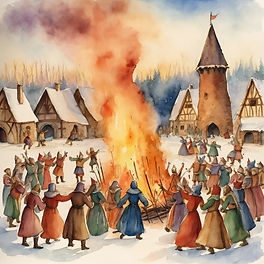
The Winter Solstice Festival celebrates the fire that keeps people warm during the winter months. It also celebrates war and fighting, since Tresimir is the god of fire and war. Priests of Tresimir will usually offer a sacrifice of blood, in the form of an executed criminal or a straw man representation of a criminal. They will behead the sacrifice and throw the sacrifice into a bonfire which they will burn for flammesten. People usually then dance around that bonfire.
Tournaments are usually held to demonstrate the prowess of fighters. Many people will watch these fights as a form of entertainment. Fire dancers perform at night.
Ice Festival
The Ice Festival is dedicated to the god Hvitbon. It starts Manday, the 9th of the month Hvitman, which occurs around our version of January 20 or 21. It lasts three days (like every festival).
The Ice Festival is a celebration of the beauty of winter and the goodness of the god of winter in allowing people to prepare each year before the frost starts. Traditionally, during the week prior to the festival, celebrators will perform some form of fasting, either by reducing the number of meals per day, or spending some of the days refraining from eating entirely. In place of fasting, celebrators will give up an animal, bales of crops, or a sum of money to the priests of Hvitbon to be distributed to the poor during the festival. Many make their donations in conjunction with their fasting. The purpose of this endeavor is to recognize the power of the god of Winter to take away the necessities of life and inflict death in its place. The fasting/sacrifice is to show reverence and respect for his power, so he is not angered, and will not inflict his wrath upon you. The donations of money, food, or animals are also to help poor and struggling families so they can live through the winter and be able to prepare better the next winter.
Despite the original intent of the festival, the Altruists have subverted the intention by placing the collection of the Head Tax and Property Tax in the week leading up to the festival. They do this, as they say because the Head Tax is a form of sacrifice for the good of the collective. The purpose of the Head Tax is to fund the army and guards for defense. The original time of the Head Tax collection was during the month of Hectum, but with the creation of the Victory of Styxa, the Altruist leaders did not want the Head Tax collection to mar the image of the festival. Therefore, they moved the Head Tax collection to the week before the Ice Festival to coincide with the traditional fast and sacrifice. Because of this, most people, unless they are either rich and generous, devotees of the god Hvitbon, or live in more Northern regions, do not participate in the voluntary fast/sacrifice, because they consider the Head Tax to be their sacrifice. There is a certain amount of fasting that takes place, even in non-northern regions, enough that some poor people can receive assistance from the priests of Hvitbon. However, this assistance is not enough to satisfy the needs of all who come to the priests for assistance, as it was previously.
For the festival, priests of Hvitbon will say prayers on behalf of the populace to appease the wrath of Hvitbon, in order for people to see the beauty and not the wrath of winter. People who are struggling can come to the priests for assistance and a prayer on their behalf, so they and their families can survive the winter.
During the Ice Festival, many people will celebrate by ice skating, ice sculpting, building snow and frost decorations, and other winter activities. It is traditional to consume hot beverages, meat, and potatoes. Children, with the assistance of their parents, will carve potatoes into animals or artistic shapes and then fry and eat them.
It is to be noted that southern or coastal regions where there is no snow do not strongly adhere to traditional Ice Festival celebrations. However, if a region is under Altruist control, they get the festival off regardless of whether or not they celebrate
Non-Altruist controlled regions still collect the Head Tax during the month of Hectum. This is considered more popular and humane, as families are not forced to give up money when they are struggling to get through the winter.