


Taxation
Head Tax
In the days leading up to the Ice Festival, all persons are required to give the tax collector a gold coin or the equivalent value. If the person is a minor, then a parent or ward is required to give a gold coin or the equivalent value on their behalf.
Every person, male or female, rich or poor, with papers or without papers, is required to give the head tax to the tax collector of whatever barony or county they are in. The only exceptions are knights, soldiers, guards, defenders, priests/priestesses, Librarians, and royalty.
The purpose of this tax is to help fund defense and the guards, which is why knights, soldiers, guards, and defenders are exempt. Priest and priestesses are exempt out of deference to the gods. Royalty and Librarians are exempt from most taxes.
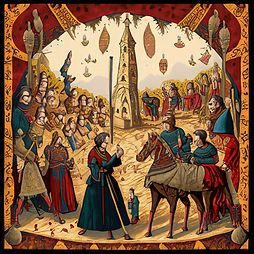
This is an AI Generated Image.
Magic Tax
All magic gems, charms, wares, spells, textbooks, or instruction are all taxed at the rate of 20%. The only exception is flammesten, or any charms, spells, textbooks, and instruction solely involving healing. Flammestens and healing charms, spells, textbooks, and instruction have a 10% tax.
While the government sets the prices for all magic gems, individual businesses can set their own prices for magic charms, wares, spells, textbooks, or instruction. These prices, however, can only be changed once every three months, and all prices must be reported to the local barony or county responsible for the tax collection. The government keeps track of these magic gems, charms, wares, spells, and textbooks by conducting a brief inventory every three months and then subtracting the difference between the previous three months' inventory, including any receipts for magic gems, charms, wares, spells, or textbooks purchased from suppliers. Local governments keep stringent checks on any sales of magic gems, charms, wares, spells, or textbooks. A whole office, the Department of Magic, is dedicated to the tracking and administering of this tax. Businesses must be licensed to deal in magic gems, charms, wares, spells, textbooks, or instruction. Ordinary business licenses do not suffice for dealing in magic gems, charms, wares, spells, textbooks, or instruction, and ordinary business people can receive extreme fines and even go to prison if they are found dealing in these magic gems, charms, wares, spells, textbooks, or instruction without permission. This is to help the Department of Magic keep track of the Magic Tax.
Schools of magic instruction also must pay a magic tax for magical instruction or teaching of the fae languages. Magic schools collect the the tax per student based on the tuition. Royalty, Librarians, and their wards are exempt from paying this tax. Royalty and Librarians do not have to have documentation to show that the pupil is blood-related, or show that they are the ward of that pupil. They do not even have to admit any relationship or connection with that pupil. All the school has to demonstrate to the tax collectors is that a member of the Royalty or Librarians is paying the tuition on behalf of the pupil. If a city school wants to teach fae languages in their curriculum but is otherwise not a magical school, they are required to pay a flat gold coin fee per student, per semester, per class to the state. Magic tax for magical instruction is collected by Marquis and Dukes, not by the local baronet, barony, vi-county, or county. Only accredited or licensed institutions can charge for or provide magical instruction. Violators can receive heavy fines and/or imprisonment.
Magical apprenticeships can be formed, where a master teaches an apprentice magic. However, the apprentice cannot pay the master to receive this magical instruction, otherwise, it is illegal. The apprentice is free to monetarily benefit their master in the form of free or discounted labor.
An industry or business might use magic wares to deliver products or services. There are no taxes associated with this, only taxes associated with the purchasing of the magic gems, charms, wares, spells, or textbooks associated with the manufacturing of that product or service. This includes services such as healings performed by healers or physicians, mounting of gems on charms or pendants, and installations or maintenance of magical wares in a home or other facility.
Except for gems, the magic tax is applied at every level of the magic trade. Magic taxes can be paid multiple times on goods, especially if they are bought and resold to more distant markets. The cost of the gem in a magic good is subtracted from the cost of the magic ware, and the tax of the gem is only applied to the final sale of the good, but the cost of the rest of the ware is applied at every level of the magic ware's exchange. Because of this, magic wares, such as charms are usually made or assembled by local merchants and sold directly to a customer.
In order for the sale of a magic ware to not be considered a 'final sale', the merchant must have a license to sell magic wares and report any increase in inventory both to the local division(s) of the Magic Department in the county or barony wherein relevant purchases are made and to any division(s) for regions wherein they plan to sell. In the event that an audit finds a reported item missing from a merchant's inventory, the missing item will be presumed to have been sold to a consumer in a 'final sale'. The tax will then be charged with the inclusion of the magic gems.
It is to be noted that Royalty and Librarians are exempt from Magic Tax. However, a vendor may require the Royalty or Librarian to sign a statement to note that the Royalty or Librarian is making the purchase. This is for tax purposes, as magic gems, charms, wares, spells, and textbooks are carefully inventoried and monitored by government officials. Any difference in inventory requires the payment of the magic taxes. If the purchaser is Royalty or a Librarian, a note is required, along with the amount purchased to allow the tax collector to know what amount of inventory must be subtracted from the total inventory taxed.
Religious texts, even ones that contain spells are also exempt from this tax, but only if the texts have been approved as religious texts by the archpriest/priestess of that sect of that specific country.
Luxury Tax
The luxury tax is a sales tax that applies to jewelry, watches or clocks, gold-leaf items of any kind, furs, skins, feathers, taxidermied animals, art, carriages, windows, exotic animals, sugar, tea, coffee, vanilla, chocolate, lace, silk, velvet, cotton, vivid dyes, and cosmetics. The sales tax is ten percent of the price of the good. It applies to every sale of the good, in whatever stage the good is purchased. The only exception is in the sale of prepared food, such as sold by vendors or restaurants, where the luxury item is one of the ingredients of the prepared food. The tax is applied to the vendor or restaurant buying the raw goods from a supplier, but not to the prepared food served by the vendor or restaurant.
The sale of luxury goods must be reported to local authorities. Receipts must be provided for every purchase or sale and filed with the local tax collector. Quantities are monitored at certain points of import, and with random inventory inspections. Inspections usually only happen once a year but can happen more frequently if inspectors feel that there is something unusual with the paperwork filed. The Department of Luxury Items deals with the taxation and monitoring of luxury items. The Department of Luxury Items is smaller than the Department of Magic and is therefore not as thorough at the monitoring and enforcement of the tax.
Jewelry values require a licensed appraiser to determine the value. Appraising licenses and licenses to run jewelry stores are granted by the Department of Luxury Items. Jewelry is defined as any necklace, bracelet, brooch, ring, crown, hairpiece, or piercing that is made with metal, glass, or any kind of precious, non-magical gems.
Fur is defined as any animal fur, other than leather, which has been removed from an animal with the skin. Therefore, wool, angora, and other such materials are not included in the luxury item category. Leathers are also not included in the luxury item category. Animal tails that have fur on them are included in the category of furs, whether or not skin is attached to the tail.
Skins that fall in the luxury item category specifically refer to reptile skins. Other animal skins, such as fish and birds, are not included.
Art refers to any work, whether painted, sculpted, blown, or sewn, that primarily serves an ornamental or aesthetic purpose. If it serves another purpose, such as being a coat-stand or a fountain, it is not classified as art, and the tax does not apply.
Carriages refer to any vehicle pulled by animals, which has a roofed compartment with four walls, meant for the transportation of people.
The luxury tax for windows applies to any pane of glass, meant for installation in a building for the purpose of looking outside, which pane of glass is also longer than a foot in length or width. Because of this, most middle-class homes have windows connected by a lattice or grill framework to avoid the tax. Upper-class homes may specifically have large windows without a lattice connecting them to demonstrate their wealth.
Exotic animals refer to any non-insect, non-fish, or non-amphibious animals that are not considered common. Animals considered common are chickens, geese, ducks, cave-pheasant, crows, pigeons, rabbits, hares, dogs, cats, mice, rats, goats, sheep, pigs, hogs, cows, bulls, oxen, horses, donkeys, and mules. All other non-insect, non-fish, or non-amphibious animals require a luxury tax to sell if alive, or if dead but not skinned or butchered.
Sugar only refers to sugar made from sugar cane or sugar beets.
Vivid dyes refer to any clothing dyed with red, orange, purple, indigo, or pink dyes.
Only a king and his family are exempt from luxury taxes.
Weapons Tax
A twenty percent tax is applied only to the final sale of weapons. It is not applied to middle-man purchases. This tax is tracked by the Department of Commerce.
Something is classified as a weapon if it is a sword or knife with at least a nine-inch blade. Maces, spears, polearms, and bows are considered weapons. Staffs are not considered weapons if they have no blade, sharp point, or offensive spell on them. Axes are classified as weapons if they have a thin blade (as opposed to the thick blade used for wood-chopping axes and hatchets). Whips are not considered weapons unless they have spikes or bones in the whips.
Guards, defenders, knights, government officials, nobility, Librarians, and royalty are not subjected to the weapons tax.
Trebuchets and catapults are illegal to own by non-government individuals.
Wage Tax
The wage tax is 10% of a person's wage, as is applied to regular employees. Day laborers are not subjected to wage taxes. The Office of Labor tracks the Wage Tax.
Employees in magical industries (except for healing industries) are taxed at 20%.
Government employees are not subjected to wage taxes. Royalty and Librarians are not subjected to wage taxes.
Movement Tax
This is a flat tax of one bronze applied anytime a person or animal crosses the border into another Altruist-Allied country. The tax is two bronze for persons crossing to or from non-Altruist countries. If a person crosses the border, via porta lunae or boat, the tax is collected by the seller of the ticket. If someone crosses the border by foot, border patrols are responsible for collecting the taxes.
Import/Export Tax
This is a tax applied to any goods meant for sale being imported or exported from different countries. The tax is different depending on the type of good, and from what country it is being imported. Imports/Exports from or to non-Altruist countries get increased penalties that Altruist-Allied countries. This tax is applied regardless of whether the good is considered a luxury or non-luxury item, and does not affect other taxes placed on a good.
Property Tax
This is a yearly tax applied to any non-state property. The tax is set at two percent of the most recent purchase price of the property.
If the local government deems that a particular piece of property has been significantly undervalued (more than twenty percent of the government's estimated cost), the local government may have two (or more) independent evaluators evaluate the price of a particular property. The property tax will then be determined as two percent of the average of the evaluations.
If a property owner disagrees with the new property tax as determined, they may submit their own evaluations taken by independent contractors. The number of their evaluations submitted cannot exceed the number of evaluations submitted by the local government. Then all evaluations will be averaged, and that average will be what is used to calculate the property tax.
The property tax goes to the local baron/baronet. They are then responsible for passing half of those earnings to their local count/viscount/baron. In turn, they are responsible for passing half of those earnings to their local marquis/count/count/viscount, and so on until it reaches the king.
Property owned by royals and librarians, as well as property used for approved religious purposes, is exempt from property taxes.
Temporary Business Permit
This is a fee applied to any seller of goods or services who sells more than three items or services in total. It is one bronze per week in operation. No document verification is needed to obtain a temporary business permit. This tax goes to the local government.
(Annual) Business Permit
This is a fee applied to any seller of goods or services who sells more than three items or services in total. It is five gold per year in operation. Document verification is required to obtain a business permit. This tax goes to the local government.
Business Tax
This is a fee applied to any seller of goods or services who sells more than three items or services in total. It is five gold per year in operation, or one bronze per week of operation for businesses with only temporary permits. This tax is divided by the regional and national governments. While it is enforced by the local government. However, there are officials who review the Business Permit and Temporary Permit records to ensure that the local government is not collecting more revenue in Temporary and Annual Business Permits than is sent in Business Tax revenue to the regional and national governments.
Multiple Asset Ownership Tax
Persons who own four or more properties, businesses, apartments, or stakes in an investment venture valued at five hundred gold, must pay a one percent tax for the first three assets starting with the fourth asset. Then they pay a two percent tax on the next three, a three percent tax on the next three, and so on until the rate hits ten percent. There it remains for each additional asset valued at five hundred gold or more. Persons can decide which asset is taxed at which rate.
If the local government deems that a particular asset, business, or piece of property has been significantly undervalued (more than twenty percent of the government's estimated cost), the local government may have two (or more) independent evaluators evaluate the price. The multiple-asset ownership tax will then be determined as two percent of the average of the evaluations.
If the asset owner disagrees with the new tax as determined, they may submit their own evaluations taken by independent contractors. The number of evaluations submitted cannot exceed the number of evaluations submitted by the local government. Then all evaluations will be averaged, and that average will be what is used to calculate the property tax.
The tax of each asset goes to the local area in which that asset is primarily located. The multi-asset ownership tax goes to the local baron/baronet. They pass half the earnings to the local count/viscount/baron. In turn, they also pass half the earnings to the local marquis/count/ count/viscount, and so on until it reaches the king. In the case of ownership or part ownership of sea-faring ships or sea voyage investment ventures, the asset tax is paid to the county of the owner's primary residence. The tax is similarly passed up the levels until it gets to the king.
Assets owned by royals and librarians, as well as property used for approved religious purposes, are exempt from multi-asset ownership taxes.
Vice Tax
This is a percentage tax applied to businesses subjected to the Vice Tax. Vice Taxes are applied to businesses or organizations that host tournaments or fights (other than governments or educational institutions), host gambling or lotteries, provide hard liquor (over twenty-proof), are sex-oriented, are deemed blasphemous or anti-government, or engage in other activities that the local government deems are vices to the community. Local governments may also apply Vice Taxes to businesses that refuse to comply with local ordinances or act against the public interest. Such examples are main street businesses that refuse to have a locally designated style of storefront, herbal shops that refuse to sell abortifacients, magic shops that do not sell pregnancy-protection charms, shops or businesses that refuse to serve certain races, etc.
The Vice Tax has four levels of classifications where the business pays a certain percentage or all their business earnings (this is applied to the sales, not the profit). Level 1 has a one percent tax. Level 2 has a two percent tax. Level 3 has a five percent tax. Level four has a ten percent tax. The levels are assigned depending on the severity of the Vice determined by either provincial law or the local government.
If a business/company thinks that a Vice Tax has been unfairly applied to them or that they have been assigned a level higher than they deserve, that business/company can file a lawsuit in court. If a judge determines that the Vice Tax has been unfairly applied to them, or that they were assigned a higher level than deserved, the local province must compensate them. That compensation is the cost of court and lawyer fees plus double the amount of money lost due to the unfair designation, up to three years prior to when the case was initially filed. The local government must entirely pay this fee, whether or not they have already paid a percentage of the tax collected forward to the local count/viscount/baron.
The Vice Tax goes to the local baron/baronet. They are then responsible for passing half of those earnings to their local count/viscount/baron. In turn, they are responsible for passing half of those earnings to their local marquis/count/count/viscount, and so on until it reaches the king.