


Elvish Races
Elves/High Elves
CLICK TO SEE ENLARGED IMAGE
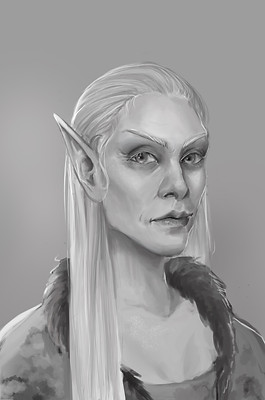
The high elves, or elves, are a diurnal species. They naturally absorb magic from the environment. They are one of the three species of Elves. Those originating in eastern and northern Serracole have fair pale human-esque skin shades, while those originating in southern Serracole have medium pale human-esque skin tones. They have white blonde, pale blonde, blonde, brown, red, and black hair colors. They have brown, blue, green, and gray eye colors. The average high elf male and female are about 6'3'' and 5'10'' (1.91/1.78 m) respectively, and they are typically thinner than the average person. High Elves have tall pointed ears and human-like features. Their hair grows long and is straight. High Elves have a lifespan of 160-170 years. High elves reach maturation typically around 20 and are considered adults around 25. Females only ovulate once a year, and typically can only produce 1 child every five years. Males will typically stay to help raise children. They often enter into lifelong relationships with the female with whom they share offspring.
High-Elves originate from the country Serracolle. Their diets are similar to humans, though they typically abstain from red meats, as red meats are harder on their digestive tracks.
Elves have a second hole in their ears above their ear canal. This is how they absorb environmental energy. Because of environmental magic, they either can naturally use nature, wind, earth, or water magic. Wind and nature magic are the most common. High Elves have more enhanced senses than humans, but they are not as physically strong, with about 10 percent less strength than humans of their same fitness, size, and sex.
Elves are usually an insular species. They prefer to live in elvish communities, even when living in non-elvish territories. They consider themselves to be better than other races and strongly discourage interracial marriages. They will actively shun those who enter into interracial marriages but will accept those who divorce non-elvish partners back into their community. They are not opposed to liaisons with those of other species, as long as they are bipedal and the relationship is temporary.
High elves and sylvan elves with water magic are typically called water elves or nymphs. The typically live apart from other high elf communities in their own communities near the ocean or lakes.
Elves can only reproduce viable offspring with humans, nox, druids, and druidic races.
The elvish language is based on the language of Latin/Italian.
Nox/Noscoblin/Night Elves

Night elves, or nox, are a nocturnal species. They naturally absorb magic from the environment. They are one of the three species of elves. Those who originate from Tirtwyl have darker gray and black skin tones, while those who originate from northern Serracole have medium gray skin tones. Those who originate from the caves of Tirtwyl have dark purple and dark blue skin tones. Their hair colors are white, black, and various shades of gray and purple. Their eye colors are white, black, purple, and blue. The average night elf male and female are about 5'8'' and 5'4'' (1.73/1.63 m) respectively, and they are typically thinner than the average human.
Night elves have tall pointed ears and human-like features. Their hair grows long and is straight. Night elves have a lifespan of 140-150 years. Nox reach maturation typically around 17 and are considered adults around 20. Females ovulate only once a year, and typically can only produce 1 child every four to five years. Males will typically stay to help raise children. They often enter into lifelong relationships with the female with whom they share offspring.
Druids/Sylvan Elves
Nox originate from the former country Tirtwyl and the caves of Tirtwyl. Because of the conquering of their country, many night elves have retreated to the country of Gleann Rois. Many have also joined traveling communities to avoid forced inscriptions, though a lot did remain in the area of Tirtwyl. There are small communities in the caves of Tirtwyl that are entirely controlled by the nox. Their diets are similar to humans.
Nox have a second hole in their ears above their ear canal. This is how they absorb environmental energy. Because of the environmental magic, they either can naturally use nature, wind, earth, or water magic. Wind magic is the most common. Nox have more enhanced senses than humans. They have the ability to see in the dark, but no total darkness. They are sensitive to light. Nox who acclimate to diurnal schedules to participate in human society must wear dark glasses to prevent headaches or going blind when older, especially those with lighter eye colors, such as white, light purple, and light blue.
Nox are a semi-insular species. While they prefer to live in nox communities, they are not opposed to living among druidic peoples or humans. They are okay with liaisons with those of other races as long as they are bipedal. They generally discourage intermarriage but are more accepting of those that enter into marriages with druids or druidic peoples.
Elves can only reproduce viable offspring with humans, nox, druids, and druidic races.
The noxian language is based on the language of Welsh. In their language, they refer to themselves are the noscoblin.
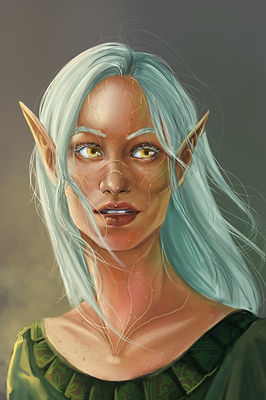
Druids or Sylvan Elves are crepuscular. They naturally absorb magic from the environment. Druids have wood-like skin tones, with medium to lighter wooden brown skin tones originating from Serracole, darker wooden brown skin tones from Gleann Rois, and reddish wooden brown skin tones from southern Croulia. They have brown, red, or green shades of hair. Their eye colors are the same as humans. They have especially long ears extending more sideways than the typical high-elf ear. They can have both straight and curly hair. Their skin will often contain natural lines reminiscent of wood grains. They are slightly shorter than the average human, the average man and woman being 5'6'' and 5'2'' (1.68/1.58 m) respectively. They have a lifespan of 115-125 years. Druids usually reach maturation by 16 and are considered adults at 18.
Druid women only ovulate once a year. They have 1 to 2 children per birth and can give birth every three to four years. In the event of multiple births, only one of the children will be male, or both will be female. Because of this, fifty-eight percent of the population is female. Males usually stay to help raise children. They often enter into lifelong relationships with the female with whom they share offspring.
Druids originate in the country of Gleann Rois but have spread northward across the country of Croulia, Gattenwood, and the former country of Tirtwyl. There are even some druidic communities in Nortram, though they are not as common. Their diets are similar to humans.
Druids have a second hole in their ears above their ear canal. This is how they absorb environmental energy. Because of environmental magic, they can naturally use nature, wind, earth, or water magic. Nature magic is the most common. Druids have enhanced senses. However, they are not quite as strong as humans, with about 10 percent less strength than humans of their same fitness, size, and sex.
Druids were not insular prior to the Altruist movement. After the Altruist movement, they became more insular concerning their communities. They do freely interact with kitseeth, fiaseeth, nox, and humans not aligned with Altruist causes. Because of their affinity with nature magic, they are highly sought after as farmers in many countries. Druidic farmers form druidic communities in whatever county or barony they live.
High elves and sylvan elves with water magic are typically called water elves or nymphs. The typically live apart from other high elf communities in their own communities near the ocean or lakes.
While druidic communities usually have normal male/female relationships, because of the larger proportion of females, certain communities are polyamorous. These communities will have ten to twenty men who are the sires to two to ten women each. The women in these communities enter into coitus with only one of the males (usually marrying them), and will also sometimes engage in coitus with females of the colony. These colonies are typically matriarchal, with the women raising the children. Males are actively involved in raising their own male children, with limited involvement with the female children depending on the number of children they have. The polyamorous communities typically live separately or on the outskirts of regular monogamous communities.
Elves can only reproduce viable offspring with humans, nox, druids, and druidic races.
The druidic language is based on Gaelic/Irish.
Druidic Races
Kitseeth

The kitseeth are a druidic race, and they are crepuscular. They naturally absorb magic from the environment. Kitseeths have skin tones similar to cats as well as similar eye and hair colors. They have a druid body from the head to the loins and a cat's hind legs from the bottom to the feet. They also have retractable claws, cat ears, and cat noses. Their skin and fur color are generally the same shade, or subtle variations (one being a lighter or darker version of the same shade). They can have both straight and curly hair. They are slightly shorter than the average human, the average man and woman being 5'6'' and 5'2'' (1.68/1.58 m) respectively. They have a lifespan of 90-100 years. Kitseeths usually reach maturation by 15 and are considered adults at 17.
Kitseeth women only ovulate once a year. They have 1 to 3 children per birth and can give birth every three to four years. In the event of multiple births, only one of the children will be male, or all will be female. Because of this, sixty-four percent of the population is female. Males will often stay to help raise children. They typicall enter into lifelong relationships with the female with whom they share offspring.
Kitseeths originate in southern Croulia, just north of the border of Gleann Rois but have spread northward across the country of Croulia, south into Gleann Rois, and eastward into the former country of Tirtwyl. Their diets are similar to humans.
Kitseeths have a second hole in their ears above their ear canal. This is how they absorb environmental energy. Because of environmental magic, they either can naturally use nature, wind, earth, or water magic. Nature magic is the most common. Kitseeths have enhanced senses and are especially good at jumping and landing on their feet. They are not as strong as humans, with about 10 percent less strength than humans of their same fitness, size, and sex.
Kitseeths were not insular prior to the Altruist movement. After the Altruist movement, they became more insular concerning their communities. They do freely interact with druids, fiaseeth, nox, and humans not aligned with Altruist causes.
While druidic communities usually have normal male/female relationships, because of the larger proportion of females, certain communities are polyamorous. These communities will have ten to twenty men who are the sires to two to ten women each. The women in these communities enter into coitus with only one of the males (usually marrying them), and will also sometimes engage in coitus with females of the colony. These colonies are typically matriarchal, with the women raising the children. Males are actively involved in raising their own male children, with limited involvement with the female children depending on the number of children they have. The polyamorous communities typically live separately or on the outskirts of regular monogamous communities.
Elves can only reproduce viable offspring with humans, nox, druids, and druidic races.
The kitseeth speak the druidic language. The druidic language is based on Gaelic/Irish.
Fiaseeth
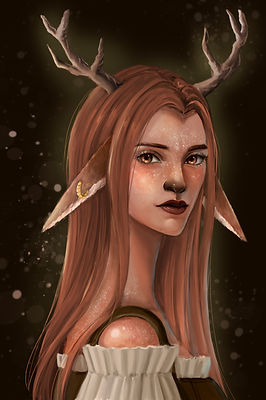
The fiaseeth are a druidic race, and they are crepuscular. They naturally absorb magic from the environment. Fiaseeth have skin tones similar to deer as well as similar eye and hair colors. They have a druid body from the head to the loins and a deer's hind legs from the bottom to the feet. They also have antlers, white freckles, deer ears, and deer noses. Their skin and fur color are generally the same shade, or subtle variations (one being a lighter or darker version of the same shade). They can have both straight and curly hair. The average man and woman are 5'10'' and 5'6'' (1.78/1.68 m) respectively. They have a lifespan of 90-100 years. Fiaseeths usually reach maturation by 15 and are considered adults at 17.
Fiaseeth women only ovulate once a year. They have 1 child per birth and can give birth every three to four years. Males will typically stay to help raise children. They often enter into lifelong relationships with the female with whom they share offspring.
Fiaseeths originate in southern Croulia, between the borders of Gattenwood and Tirtwyl, but have spread northward across the countries of Croulia, Gleann Rois, and the former country of Tirtwyl. They are herbivores.
Fiaseeths have a second hole in their ears above their ear canal. This is how they absorb environmental energy. Because of environmental magic, they either can naturally use nature, wind, earth, or water magic. Nature magic is the most common. Fiaseeths have enhanced senses and are especially fast runners. They are not as strong as humans, with about 10 percent less strength than humans of their same fitness, size, and sex.
Fiaseeths are an insular species. They do freely interact with druids, kitseeth, and nox. Certain fiaseeth communities interact with centaurs as well, but not all fiaseeth communities do so. They are typically afraid of other species.
Elves can only reproduce viable offspring with humans, nox, druids, and druidic races.
The fiaseeth speak the druidic language. The druidic language is based on Gaelic/Irish.